By James Phillips
“You cannot simultaneously prevent and prepare for war.” That statement, attributed to Albert Einstein, is ominously appropriate for the current situation. This is the state of things. In the past few months the United States, under the Trump regime, has built a massive presence of military might in the Caribbean region. As of October 20, there were approximately ten thousand U.S. troops at sea and on shore in the region, the largest deployment of U.S. forces there in decades.
The military has blown up small boats in the southern Caribbean, killing people whom the Trump Administration claims were drug runners. The murdered were mostly fishermen, citizens of Venezuela, Colombia, Ecuador, and Trinidad-Tobago, according to their governments’ reports. In peaceful times, drug runners would be intercepted in or near U.S. waters by the Coast Guard, taken into custody, and tried. These Caribbean fishermen were simply murdered with no chance to prove their innocence. The attacks and murders seem to be continuing.
The Administration has posted eight Navy warships with 2200 Marines and fighter jets. In the Caribbean. A military contingent is assembled at air and naval bases in Puerto Rico, with intelligence and surveillance facilities in the Virgin Islands.This contingent includes Marine Corps F-35 fighter jets and Air Force MQ-9 reaper drones which can be used for reconnaissance and for striking targets. Two large Navy replenishment ships that deliver fuel and supplies to warships were also seen at dock in Puerto Rico.
On October 15, at least two B-52 bombers flew off the Venezuelan coast for several hours as a “show of force,” according to a senior U.S. official. An Army Special Operations unit has been flying helicopters over the strait between Venezuela and Trinidad-Tobago where residents also reported seeing Navy surveillance planes flying over southern Trinidad a few miles from the Venezuelan coast. On October 19, the New York Times reported that a ship capable of serving as a Special Operations headquarters was seen by satellite imagery about 85 miles off the Venezuelan coast.
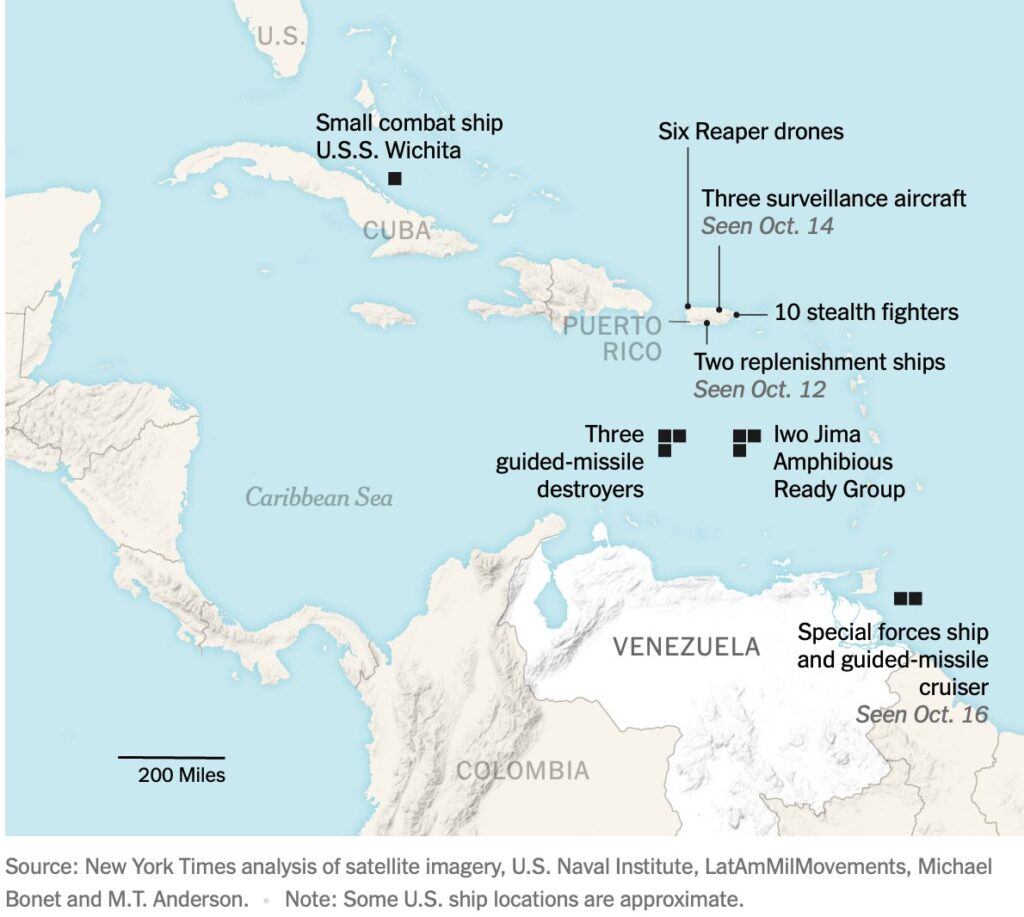
U.S. military officials say these are simply “training missions,” not preparation for an invasion. But President Trump has said repeatedly that he wants regime change in Venezuela, and specifically that he wants U.S. control over Venezuela’s large oil reserves, reportedly the largest in the world. To the east of Venezuela is the independent republic of Guyana, sparsely populated and home to large oil reserves, as well as gold and diamond deposits. To Venezuela’s west lies Colombia, whose President, Gustavo Petro, has been a harsh critic of President Trump and has not allowed Colombia to be used as a staging ground for political and military action against Venezuela, as the previous Columbian government had. To the south is Brazil with another President, Ignacio Lula da Silva, critical of the Trump regime.
In a recent “secret” directive, Trump has authorized the CIA to conduct undercover operations in Venezuela and elsewhere. Anyone with any knowledge of the region knows that the CIA and its front organizations are another arm of warfare against governments that Washington does not like. There is a long history to CIA mischief in the Caribbean.
The current U.S. saber rattling threatens more that Venezuela. Other obvious targets of Washington’s longtime obsession with regime change are Cuba, Nicaragua, and Honduras. Cuba is emblematic of a country flagrantly independent of U.S. control. Destroying Nicaragua’s Sandinista revolutionary government was an obsession of the Reagan Administration in the 1980s (hence the Contra War and the Iran-Contra Affair), and deposing Daniel Ortega’s government remains an obsession with many U.S. officials today, despite (or perhaps because of) Nicaragua’s success in providing improved living standards of its people despite U.S. sanctions and despite being among the poorest countries in Latin America.
For decade, Honduras was a faithful colony of the U.S. and the staging ground for the CIA coup against the Arbenz government in Guatemala in the 1950s—Arbenz tried to push through a land reform and the U.S. banana and fruit titans felt threatened—and the Contra War against Nicaragua in the 1980s. But the current Honduran government of Xiomara Castro has been less willing to support every U.S. action in the region, and this is an election year in Honduras. Honduras is not a target of U.S. sanctions, but the government has been threatened with four billion dollars (a sizable portion of the country’s entire budget) in claims by U.S. and other corporations demanding repayment for the Honduran government’s cancellation of projects that impoverish the Honduran people. The message is that Caribbean governments are not allowed to protect their own people, neither in Honduras nor anywhere else in the Caribbean under U.S. influence.
The current situation may resemble old style “gunboat diplomacy,” But military threat is today accompanied with heavy economic sanctions and negative media propaganda. Cuba, Venezuela, and Nicaragua are the major targets of these warlike actions that affect the people of these countries. All three countries are currently under several sets of extensive economic sanctions. But the Trump regime has been extending the economic and propaganda war to other countries in the region, especially Colombia. Trump accuses Colombian President Petro of running a major drug smuggling racket in the region, an accusation that is refuted by various sources.
The current military buildup is calculated to increase pressure as economic and propaganda warfare soften up governments in the region for military strikes. If Trump, Marco Rubio, and the Washington regime do not get their way now, military action is the obvious next step. A side effect of this military madness is that it diverts our attention from the Jeffrey Epstein scandal, the ICE raids, and other unpopular Trump “policies.” There is nothing as effective in propping up a deeply unpopular President as a little war to protect the American people from Caribbean fishing boats.
The current situation is a continuation of over a century of U.S. military and economic intervention in the Caribbean—“our lake”— of dozens of military invasions and interventions in various countries. Every country in the Caribbean region is acutely aware of this history. As a reminder, here are a few: Guatemala (1954), Cuba (1961 and on), Guyana (1964), Dominican Republic (1965), Jamaica (1970s, Chile too), Grenada (1983), Nicaragua (1980s Contra War, and again in 2018), Panama (1989), Haiti (constantly), and so on.
The difference this time is the sheer size of the U.S. military deployment and especially the deadly precision and efficiency of the death and destruction technology employed. The deployment of such a lethal force is already an act of war. Whether it stops there is anyone’s guess. When Reagan ordered the military invasion of Grenada in 1983, the former Prime Minister of Barbados argued that the region should solve its own problems without U.S. intervention—a conviction shared by many. He remarked, “Here comes Reagan, back in the saddle, fresh out of the corral, guns blazing and looking for a fight.”
So the Trump regime may try to take us into war, not against China or Russia, but against what he perceives as weaker and more vulnerable targets in the Caribbean. The people of these countries know what they have to do. Do we know what we can do?
A few things we can facilitate. There is more.
- Congress should rescind economic sanctions against Venezuela and Nicaragua. This means annulling several measures passed in the past few years by Congress.
- Congress should reclaim its exclusive power to declare war, and should deprive the President of the right to wage war without approval of the Congress.
- Senator Jeff Merkley is a member of the Senate Foreign Relations Committee that oversees U.S. policy toward the Caribbean. He is receptive, and there are others.
- We should be skeptical consumers of negative “news”items about Venezuela, Nicaragua, Colombia, or other Caribbean region countries. Much of it is propaganda.
- Popular protests like the “No Kings” protest should include some focus on stopping war, intervention, and regime change in the Caribbean. “Hands off the Caribbean…”
- We should demand that the money going to fund U.S. war buildup in the Caribbean be used instead to fund disaster relief for Caribbean countries (like Jamaica) hit hard by Hurricane Melissa. Funds for war preparation should be redirected to helping the region address climate change. The Caribbean region as a whole accounts for a tiny percentage of global carbon emissions but is among the most vulnerable regions to climate change.
- In small ways, we can help to redefine U.S. national security as promoting healthy and constructive relations with our neighbors in the hemisphere.
James Phillips is a cultural anthropologist with forty years as a student of the Caribbean. He has lived in Jamaica, Nicaragua, and Honduras, and writes about social change, conflict, and human rights in the region. He is a member of the Peace House Board.