By Elizabeth V. Hallett
Fannie Lou Hamer was awarded the Presidential Medal of Freedom posthumously by President Joe Biden on January 4, 2025. This honor recognizes her significant contributions to the civil rights movement and her enduring legacy as a champion for racial justice. Hamer is the 11th Mississippian to receive this prestigious award, highlighting her impact on American history and civil rights.
The Presidential Medal of Freedom is the nation’s highest civilian honor, presented to individuals who have made exemplary contributions to the prosperity, values or security of the United States, world peace or other significant societal, public or private endeavors.
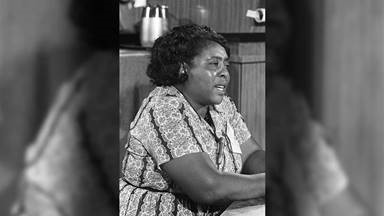
Fannie Lou Hamer
October 6, 1917 - March 14, 1977
An activist for voting rights, women’s rights, community organizer, and leader in the civil rights movement and civil rights.
Fannie Lou Hamer was born in Mississippi into a family that worked on a cotton plantation. She was the youngest of 20 children. She was capable, at the age of 13, of carrying 200-300 pounds of cotton on her back at a time. When, in 1962, her plantation boss discovered she was registering to vote, she was fired.
She was increasingly passionate about voters’ rights for Black people in Mississippi and other states as well. On August 31, 1962, she and 17 others attempted to register to vote at the Indianola Courthouse but failed the literacy test. She was turned away a second time, but passed on a third attempt early in 1963. However, that fall she was told her registration did not allow her to vote without two poll tax receipts. She paid the taxes. These experiences only inspired her activism. She became involved in the Student Nonviolent Coordinating Committee and attended Southern Christian Leadership Conferences (SCLC), sometimes teaching classes and workshops.
In June of 1963, while traveling from Charleston, South Carolina with co-activists by bus, a brutal incident took place at a local Winoa, Mississippi café. Several of them were arrested after being refused service and taken to jail. They were brutally beaten and humiliated. A SNCC representative who came to check on them the next day was also beaten for not referring to an officer in a deferential way.
A description of this incident was to form part of her testimony at the 1964 Democratic Convention when she and others, who had formed the Mississippi Freedom Democratic Party (MFDP), composed of white and black members, demanded to be formally recognized as representing a party that was for all people. The description of treatment by the State Trooper and other police who beat the SCLC members was riveting testimony. It was aired on the major news networks and seared the conscience of many in the country. This also gave national exposure to the MFDP, of which Hamer was vice-chair.
History.com described much of her notable history:
Hamer…organized Mississippi‘s Freedom Summer along with the Student Nonviolent Coordinating Committee (SNCC) and was a co-founder of the National Women’s Political Caucus, created to recruit, train, and support women of all races who sought election to government leadership.
She was known for her use of spiritual hymns and quotes and her resilience in leading the civil rights movement for black women in Mississippi. She was extorted, threatened, harassed, shot at, and assaulted by racists, including members of the police, while she was trying to register to vote. She later helped and encouraged thousands of African Americans in Mississippi to become registered voters and helped hundreds of disenfranchised people in her area through her work in programs such as the Freedom Farm Cooperative. She ran for the U.S. Senate in 1964, losing to John C. Stennis, and the Mississippi State Senate in 1971. In 1970, she led legal action against the government of Sunflower County, Mississippi, for continued illegal segregation.
Hamer died on March 14, 1977, aged 59, in Mound Bayou, Mississippi. Her memorial service was widely attended and U.S. Ambassador to the United Nations Andrew Young delivered the eulogy. She was posthumously inducted into the National Women’s Hall of Fame in 1993.
Wikipedia published a marvelous memory of the spirit with which Fannie Lou Hamer lived her life, as follows:
The Reverend Edwin King said of Hamer, “She was an extraordinarily good cook of down-home foods…she liked to mix, to make whatever she was feeding people at midnight after they would come home from jail or somewhere else, to fix the perfect spices or recipe for her guest…after she became the orator, she began picking and choosing the spicy parts she’d put in her speeches. She was always doing the best she had with whatever she had. The food, or words, or voice or song—choosing among it what was needed to persuade or to comfort or to please.”
At speaking engagements, Hamer made speeches and also sang, often with the Freedom Singer,] Charles Neblitt, one of its members, said of Hamer, “We’d let her sing all the songs we did that she knew. She put her whole self into her singing, adding a power to the group…When somebody puts their inner self into a song, it moves people. Her singing showed the kind of dedication that she had—the struggle and the pain, the frustration and the hope… Her life would be in that song.”
One of Hamer’s most famous speeches was at Williams Institutional Church in Harlem on December 20, 1964, along with Malcolm X. In the speech, “Sick and Tired of Being Sick and Tired”, she chronicled the violence and injustices she experienced while trying to register to vote. While highlighting the various acts of brutality she experienced in the South, she was careful to tie in the fact that blacks in the North and all over the country were suffering the same oppression. The audience was one third white and gave Hamer a warm reception.
Hamer died on March 14, 1977, aged 59, in Mound Bayou, Mississippi. Her memorial service was widely attended and U.S. Ambassador to the United Nations Andrew Young delivered the eulogy. She was posthumously inducted into the National Women’s Hall of Fame in 1993.
Credits:
Missisissippi Today, January 4, 2025
Wikipedia https://en.wikipedia.org/wiki/Fannie_Lou_Hamer
Also see: https://www.history.com/topics/black-history/fannie-lou-hamer
And A&E History at https://www.aenetworks.com