
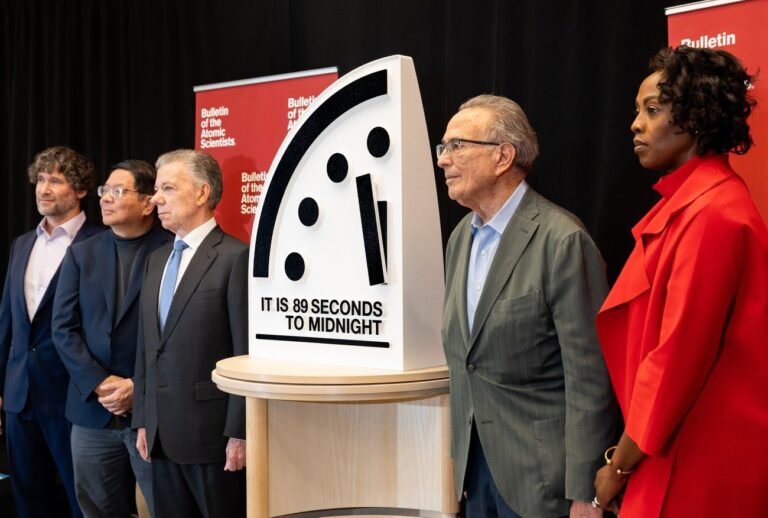
Scientists call on world leaders to take action to avoid global disaster
By Kerul Dyer
On January 28, 2025 the famous Doomsday Clock was moved from 90 to 89 seconds to midnight marking an even higher probability of a potential catastrophic global disaster. The determination of risk included those from nuclear weapons – combined with impacts from climate change, biological threats, AI use in military operations, and several other emerging concerns.
The assessment and risk factors contributing to the critical “one second” difference underwent sharp scrutiny by members of the esteemed Science and Security Board for the Bulletin of Atomic Scientists, detailed in the Bulletin’s 2025 Doomsday Clock Statement. The creators of the Doomsday Clock intend to provide leaders of the world with a stark warning and suggested actions to lower the chances of a massive disruption to life on the planet.
“In 2024, humanity edged ever closer to catastrophe,” the Statement reads. “Trends that have deeply concerned the Science and Security Board continued, and despite unmistakable signs of danger, national leaders and their societies have failed to do what is needed to change course.”
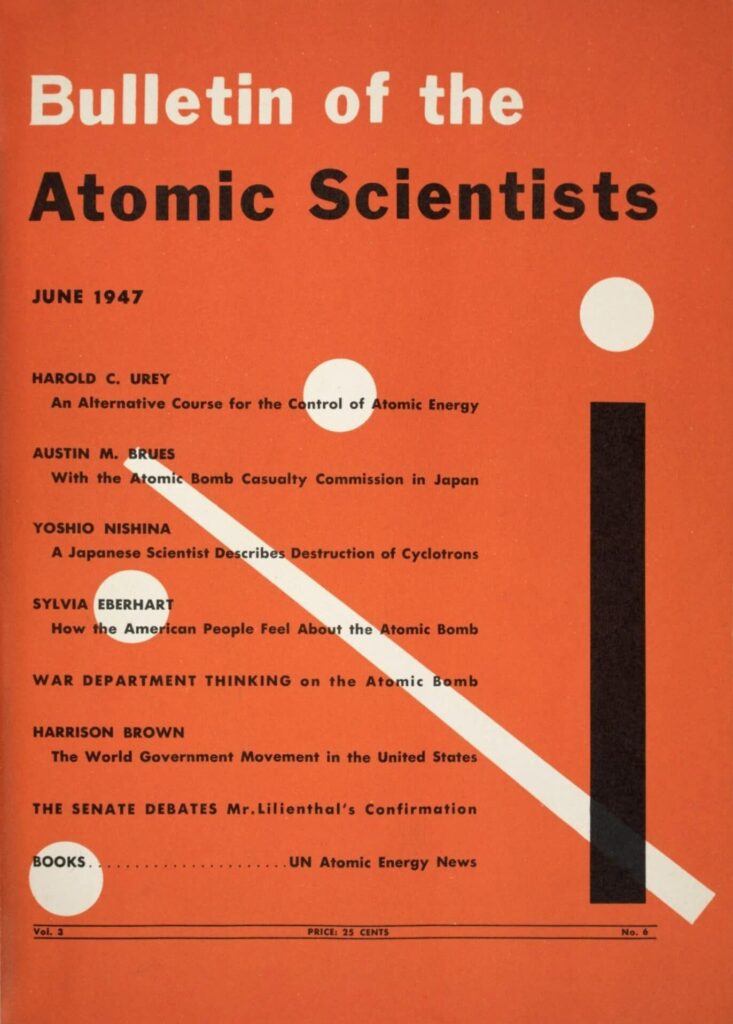
The 78-year-old Bulletin for Atomic Scientists was born out of concern by the very scientists who helped to develop the first atomic weapons through the Manhattan Project along with Albert Einstein and J Robert Oppenheimer. The group published their Bulletin as a newsletter for two years and then shifted to a magazine format in 1947. Soon thereafter, the group commissioned artist Martyl Langsdorf to illustrate a magazine cover to strike a message of great urgency, resulting in the symbolic design of a clock with its hands set at seven minutes to midnight.
Ms. Langsdorf was no stranger to nuclear technologies, as her husband worked as a physicist at the Chicago Pile No. 1 lab, a Manhattan Project facility located under a football field at the University of Chicago. The clock design and original time setting were aesthetic but led to a science-driven assessment of risk that has been used ever since to show the urgency for governments to prioritize safeguards for global survival.
The first editor of the Bulletin, a biologist, wrote that they hoped to “frighten men into rationality” when the clock’s hand was moved from seven to three minutes to midnight in 1949. The motivation at that time stemmed from developments in Soviet nuclear technology and the emerging cold war between the US and USSR. Every year since, the group has announced their assessment of disaster risk and shifted the time on the clock accordingly.
As mentioned above, the 2025 announcement marks the closest to global disaster since the group began publishing results 75 years ago. Compounding risks of quickly-accelerating climate change, expansion of biological technologies, and use of AI in military operations and ongoing nuclear threats, the Doomsday Clock provides a warning call to world leaders to take urgent action.
Sources:
https://thebulletin.org/wp-content/uploads/2025/01/2025-Doomsday-Clock-Statement.pdf
https://physics.uchicago.edu/about/our-history/manhattan-project/
https://thebulletin.org/doomsday-clock/timeline/
https://www.detroitnews.com/story/news/nation/2022/01/15/story-how-doomsday-clock-began-ticking-75-years-ago/6525564001/
https://thebulletin.org/doomsday-clock/2025-statement/